

Lead generation isn't just important—it's the single biggest priority for marketers today, with 91% naming it their top goal. Whether you're a mortgage broker, an accountant, a financial advisor, a web developer, or a copywriter, acquiring new clients and customers is essential for growing your business and achieving success.
In this blog post, we'll walk you through nine of the best lead-generation strategies to help you win new business or client leads. Our target audience is business owners and professionals based in the UK who are looking for effective and practical ways to grow their customer base.
We understand that the business landscape can be competitive, and lead generation can be challenging, especially for small and medium-sized businesses—in fact, 54% of marketers say getting better-quality leads is their biggest challenge, while 41% simply struggle to get enough leads at all. That's why we have put together a comprehensive guide that offers a range of strategies that can help you attract leads, build relationships, and ultimately convert prospects into paying customers.
Let's dive in!
Strategy 1: Networking and Referral Marketing

Photo by Product School / Unsplash
Networking and referral marketing go hand-in-hand, and both are critical components of a successful lead-generation strategy. Building professional relationships with other businesses and individuals in your industry can help you expand your network and attract new leads. Additionally, word-of-mouth recommendations from satisfied customers can help you establish trust and credibility with prospects, making it easier to convert them into paying clients.
Here are a few tips for successful networking and referral marketing:
Attend industry events and conferences to meet other professionals and expand your network.
Participate in local business organizations, such as the Chamber of Commerce, to connect with other business owners and professionals.
Offer to give presentations or host workshops to showcase your expertise and build relationships with potential leads.
Leverage your existing relationships with customers and clients to ask for referrals. Offer incentives for customers who refer new business your way.
Utilize online referral networks, such as LinkedIn, to connect with potential leads and expand your network.
Strategy 2: Content Marketing
Creating valuable and relevant content is an excellent way to attract new leads and build relationships with prospects—so much so that 85% of B2B marketers now use content marketing as part of their lead-generation mix. Content marketing involves creating and sharing content that educates and informs your target audience, such as blog posts, videos, infographics, and more. By providing prospects with useful information, you can establish yourself as an authority in your field and build trust with your target audience.
Here are a few tips for successful content marketing:
Determine your target audience and what type of content they are most interested in.
Create a content calendar to plan and schedule your content production.
Utilize various types of content, such as blog posts, videos, infographics, and more, to reach a wider audience and provide value in different formats.
Promote your content through social media, email marketing, and other channels to reach a wider audience.
Measure the success of your content marketing efforts and adjust your strategy accordingly.
Need some help writing engaging, search-engine-optimized content for your lead generation site? Our friends over at Fiverr make hiring a copywriter a breeze. And many blog writing services start from as little as £5.00.
Strategy 3: Search Engine Optimization (SEO)

Photo by Justin Morgan / Unsplash
Search engine optimization (SEO) is the practice of improving your website's ranking in search engine results pages (SERPs), such as Google. It's worth the effort: 90.7% of marketers now rely on their website as a lead-generation tool, so appearing at the top of search results puts you in front of the vast majority of your competition's audience too.
Here are a few tips for successful SEO:
Conduct keyword research to determine what keywords your target audience is searching for.
Optimize your website's content and meta tags, such as the title tag and description, to rank higher in search results.
Utilize on-page optimization techniques, such as internal link building, to improve your website's ranking in search results.
Create high-quality and valuable content that provides value to your target audience and enhances your website's overall authority and credibility.
Utilize off-page optimization techniques, such as link building, to improve your website's authority and ranking in search results.
Strategy 4: Pay-Per-Click (PPC) Advertising

Photo by Austin Distel / Unsplash
Pay-per-click (PPC) advertising is a form of digital advertising where you only pay when someone clicks on your ad. PPC advertising can be an effective way to attract new leads, especially if you're targeting a specific audience or keywords—though costs vary widely by sector, with organic-equivalent lead costs ranging from around $83 for eCommerce up to $385 for IT and managed service providers.
Here are a few tips for successful PPC advertising:
Determine your target audience and the keywords they are searching for.
Create compelling and targeted ads that resonate with your target audience.
Utilize landing pages that are optimized for conversions, with a clear call to action and a form for capturing leads.
Continuously monitor and optimize your PPC campaigns to improve results and minimize costs.
Utilize tools and technologies, such as Google Analytics, to track the performance of your PPC campaigns and make data-driven decisions.
Strategy 5: Social Media Marketing

Photo by dole777 / Unsplash
Social media marketing involves leveraging social media platforms, such as Facebook, Instagram, and LinkedIn, to reach a wider audience and attract new leads. Social media platforms offer a variety of tools and opportunities for businesses to reach their target audience, including advertising, content creation, and more.
Here are a few tips for successful social media marketing:
Determine which social media platforms your target audience is active on and prioritize those platforms.
Create a social media strategy that outlines your goals, target audience, and the type of content you will share.
Share valuable and relevant content that resonates with your target audience and showcases your expertise.
Utilize advertising options, such as sponsored posts, to reach a wider audience and attract new leads.
Engage with your followers, respond to comments and messages, and build relationships with your target audience.
Strategy 6: Email Marketing

Photo by Stephen Phillips - Hostreviews.co.uk / Unsplash
Email marketing is a cost-effective and highly targeted way to reach your target audience and attract new leads—and it remains hugely popular, with 87% of businesses using email as a lead-generation channel. By sending targeted and personalized emails, you can build relationships with your subscribers, educate them about your business, and ultimately convert them into paying customers.
Here are a few tips for successful email marketing:
Build a targeted email list of subscribers who have expressed an interest in your business.
Create a compelling and personalized email strategy that resonates with your target audience.
Utilize segmentation to target specific segments of your email list with specific messaging.
Use a call-to-action in your emails to encourage subscribers to take a specific action, such as visiting your website or booking a consultation.
Measure the success of your email marketing efforts and adjust your strategy accordingly.
Strategy 7: Influencer Marketing

Photo by Laura Chouette / Unsplash
Influencer marketing involves partnering with influencers in your industry to reach a wider audience and attract new leads. Influencer marketing can be an effective way to tap into the power of word-of-mouth marketing and build relationships with potential leads.
Here are a few tips for successful influencer marketing:
Identify influencers in your industry who have a large and engaged following.
Build relationships with influencers and offer them incentives, such as compensation or exclusive access, to promote your business.
Create a clear and concise influencer marketing plan that outlines your goals, target audience, and desired outcomes.
Utilize influencer marketing tools and technologies, such as tracking and analytics, to measure the success of your influencer marketing campaigns and make data-driven decisions.
Continuously evaluate and adjust your influencer marketing strategy to ensure you're getting the best results.
Strategy 8: Referral Marketing
Referral marketing involves leveraging your existing network of customers and clients to refer new business to you. By offering incentives, such as discounts or rewards, you can encourage your existing customers to refer new leads to you—though patience helps here too, since 63% of B2B service inquiries won't convert for at least three months.
Here are a few tips for successful referral marketing:
Create a referral marketing plan that outlines your goals, target audience, and the type of incentives you will offer.
Offer incentives, such as discounts or rewards, to customers who refer new business to you.
Utilize referral marketing tools and technologies, such as tracking and analytics, to measure the success of your referral marketing efforts and make data-driven decisions.
Continuously evaluate and adjust your referral marketing strategy to ensure you're getting the best results.
Thank and reward your customers who refer new business to you, to show your appreciation and keep the referral cycle going.
Strategy 9: Utilise a Referral Marketplace
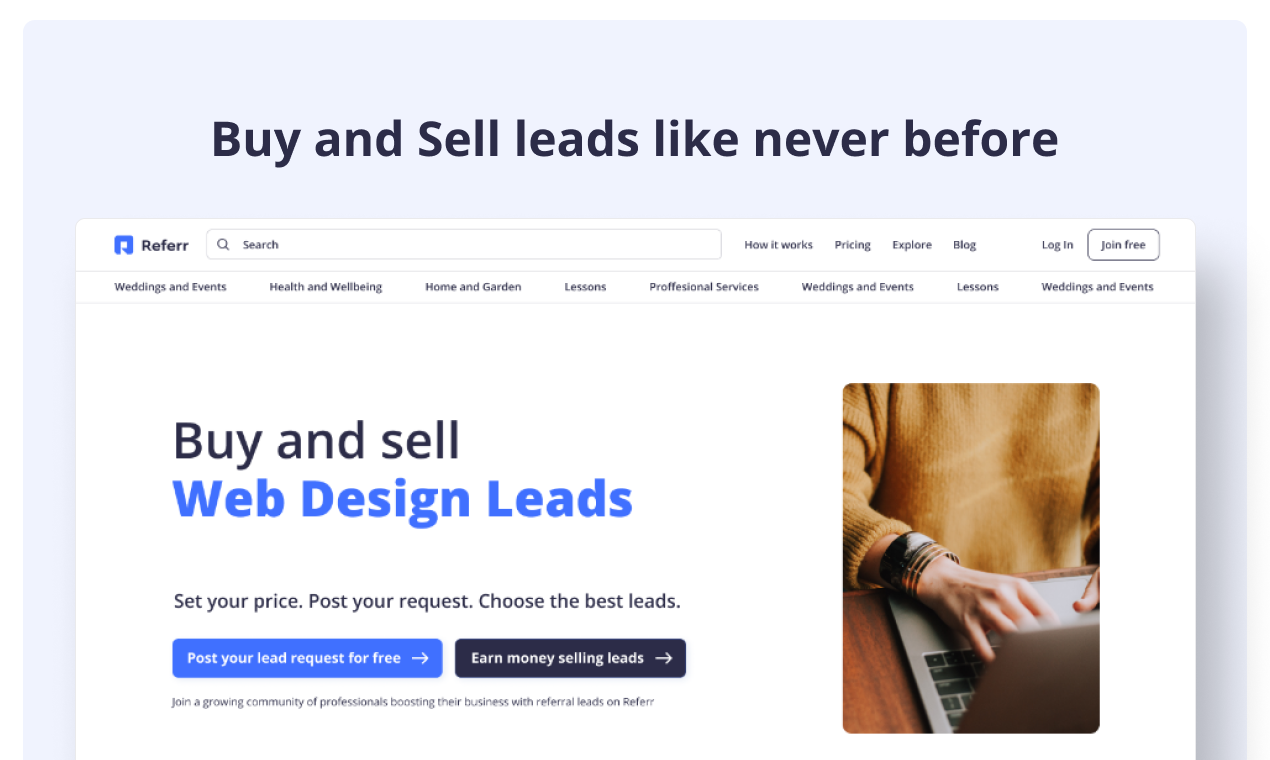
A referral marketplace, such as Referr.co.uk, allows users to buy and sell customer leads on a pay-as-you-go basis. This can be an effective way for service providers to quickly and easily acquire new leads without having to spend time and resources on lead generation—useful given that only 37% of B2B companies still rely on cold calling to fill the gap.
Here are a few tips for using a referral marketplace to generate new leads:
Sign up for a referral marketplace, such as Referr.co.uk.
Search for leads that are relevant to your business and target audience.
Purchase leads that you are interested in and get in touch with them to start the sales process.
Continuously monitor and evaluate the results of your lead purchases to ensure you're getting the best results.
Adjust your strategy and lead purchase habits as needed to continue generating new leads.
Conclusion
Generating new leads is crucial for any business looking to grow and succeed. By implementing a combination of these nine best lead-generation strategies, you can attract new leads and grow your business. Whether you're a mortgage broker, accountant, financial advisor, web developer, copywriter, or any other service provider, these strategies can help you get the results you're looking for. So what are you waiting for? Start generating new leads today!

Ready to start boosting your business with high quality clients?
Then, join Referr today and start buying and selling referral leads on the platform that puts you in control. Don't wait. Start your journey with Referr today.
Join the Referr network